

Disagreements are part of life. Whether at work, with friends, or with random people, we will always have disagreements or a difference of opinion.
However it is difficult to keep disagreements professional, rational and meaningful, else it can lead to toxic relationships, lots of conflicts, and a bad reputation.
Justice Ginsburg put it precisely when she said, “You can disagree without being disagreeable.”
I often disagree with people. Sometimes strongly. I also argue and fight with people a lot. It has resulted in lot of bitter fights, breaking of relationships and heartburns and professional setbacks. At times I have regretted some of such incidences. Thought I never critically analysed all such disagreements in general.
However, recently I read about the Hierarchy of Disagreements and it suddenly struck to me how my fights/disagreements happen. Here is the pyramid:
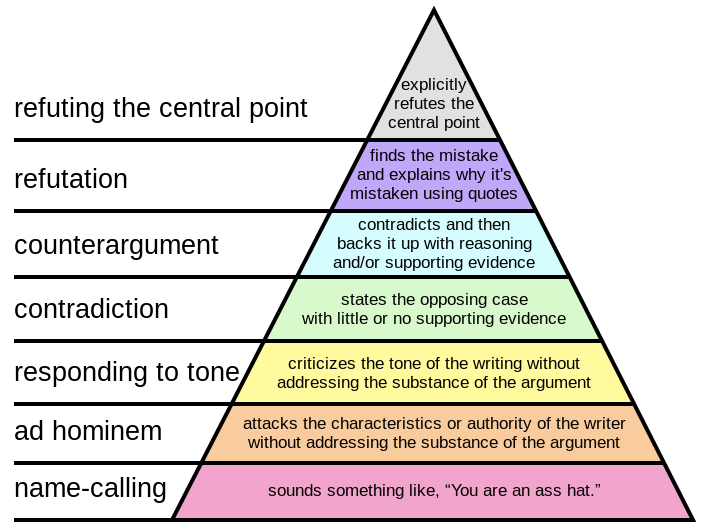
I got curious and explored more and found that actually it was proposed by Paul Graham. He wrote an essay in March 2008 titled “How to Disagree“. Do read it at leisure.
After reading the essay and carefully studying the hierarchy I was really fascinated by how valuable it is. The disagreements which are in top 3 tiers of the pyramid are of value. It’s intellectually meaningful and substantial. It leads to a situation where you don’t make permanent enemies and you let the ideas collide rather than people’s egos.
The lowest two layers of pyramid – name-calling and ad-hominem are where individual egos and personalities fight. This is where you abuse the other person, use cuss words, yell at each other and shout the other person down. Responding to tone happens when you don’t pay attention to what is said but how it is being said. This happens because of preconceived notions, biases, deep-rooted prejudices etc.
Contradiction is very common in people with headstrong personalities who are talking at each other rather than talking to each other.
I am guilty of name-calling and ad-hominem in few instances (though I never ever use cuss words). But I was always aware that I am doing it just to put the opponent down and it was not the best way and it didn’t gel with who I am. Yet I did it because, at times, winning an argument was more important; or so I used to think.
However, over the years and with a variety of experiences I have realised that you can agree to disagree and you can disagree without being disagreeable. You can simply shut the door on the people who offend you. Not necessarily forgive them, but deny them the access to your life. With passage of time it works.
Difficulty arises in two situations. First: when you cannot cut off such people from your life, for whatever reason. If you have to work with them, interact with them, or have them as a close associate/relative etc. That’s painful. I still struggle with such situations and haven’t found a good way to disagree. I end up being in the lower levels of the Disagreement pyramid.
The second situation is even more trickier. It’s when you disagree with someone who you loved/liked a lot at some point. Now you vehemently disagree because your worldview has changed. But you shared an excellent rapport with that person once. How do you adjust to the new normal and disagree in a congenial manner? I haven’t figured that out. The only way I can handle it is by cutting off that person from my life. Become total strangers.
Anyways, the art of disagreement is key to a happy and peaceful life. And Paul Graham’s hierarchy of disagreement really helps in understanding the nuances and, maybe, improve our reaction/response.


 ekoshapu
Leave a comment